Commercial mold is a business problem, not just a building problem
When mold turns up in a commercial property, the building damage is only half the issue. There are tenants with rights and health concerns, employees and customers who notice a musty smell, a business that can't simply shut down for a week, and in many cases regulatory and liability exposure that a homeowner never faces. Commercial mold remediation in Saint Paul is as much about managing those realities — scheduling, discretion, documentation, and minimal disruption — as it is about the technical removal. The work has to be done correctly and provably, while the lights stay on.
Saint Paul's commercial building stock adds its own wrinkles. The downtown core and older commercial corridors are full of century-old masonry buildings, converted warehouses, and historic structures with flat roofs, shared walls, and original construction that handles moisture very differently than a modern building. Restaurants generate enormous interior humidity. Clinics and daycares have occupants who are especially sensitive. Multi-tenant buildings spread one unit's water problem to its neighbors. Each property type calls for a tailored approach.
Property types we connect
The licensed commercial remediation firms in our network handle a broad range of Saint Paul properties, including:
- Rental and multifamily properties — apartments, duplexes, and the city's many older rental homes, where landlord obligations and tenant health are front and center.
- Offices and professional space, where the priority is remediating around a working staff with minimal downtime.
- Restaurants and food service, with their high humidity, health-code stakes, and need for off-hours work.
- Medical, dental, and childcare facilities, where sensitive occupants demand the most rigorous containment and verification.
- Retail and historic commercial buildings, including downtown's converted warehouses and masonry structures with flat-roof and envelope quirks.
- Institutional and mixed-use properties that need phased work and clear communication with multiple stakeholders.
How commercial projects run differently
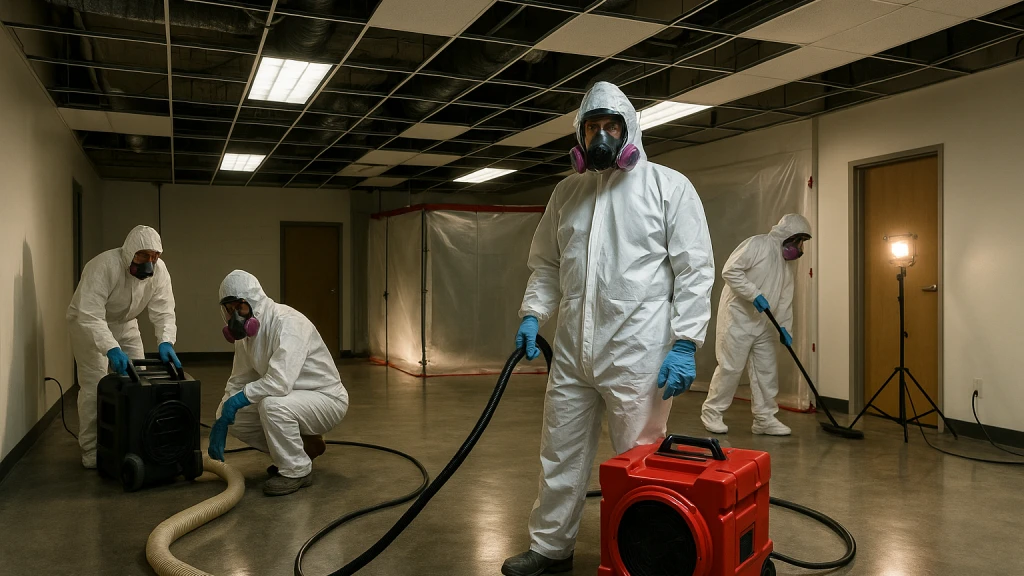
Commercial remediation uses the same containment science as residential work but layers on the project management a business requires:
- Off-hours and phased scheduling to keep the business operating, with work done overnight, in zones, or over weekends.
- Robust containment that isolates the work area so unaffected parts of the building stay open and clean.
- Tenant and occupant communication, including the notifications and coordination that landlord-tenant situations require.
- Thorough documentation — scope, photos, lab results, and clearance — for liability protection, insurance, and any regulatory file.
- Independent clearance testing to prove the space is safe before occupants return.
- Coordination with building systems, since commercial HVAC can spread mold across an entire floor or building if not addressed.
Landlords, tenants, and Minnesota obligations
For Saint Paul rental owners, mold sits inside the broader duty to maintain housing that's fit to live in. Minnesota's covenants of habitability and the city's housing-code enforcement mean a serious moisture and mold problem isn't just a comfort issue — it can become a legal and financial one if it's ignored. Tenants increasingly know to document conditions and escalate, and a slow or sloppy response tends to cost far more than a prompt, professional one. The smart play for an owner is to treat a reported mold or water issue as a priority: get it assessed, fix the moisture source, remediate properly, and keep clear records of the whole process. That documentation protects the owner as much as it protects the tenant.
Why discretion and documentation matter
A commercial mold issue handled badly can become a reputational and legal headache; handled well, it's a non-event that customers and tenants never even register. That's why the firms we connect emphasize discreet, professional execution and a complete paper trail. For a restaurant, that means resolving the problem without a public scene that ends up online. For a medical office, it means verifiable clearance before patients return. For a landlord, it means a documented, code-aware response that holds up if it's ever questioned. The remediation itself follows the same fix-the-water, contain, remove, dry, verify sequence as any other job — but the wrapper of scheduling, communication, and documentation is what makes it work for a business.
What commercial remediation costs
Commercial pricing is more variable than residential because scope, building type, and operational constraints differ so much — off-hours work, complex containment, and code or regulatory requirements all factor in. The most reliable path is a site assessment and a detailed, itemized scope rather than a phone estimate, and for larger properties it's worth getting more than one. Many commercial mold events stem from a covered water incident, so coordinating with your carrier and keeping thorough documentation is central to managing the cost. If you own or manage a Saint Paul property with a mold or moisture problem, tell us about it and we'll connect you with a licensed commercial remediation firm for a confidential, no-pressure assessment.