
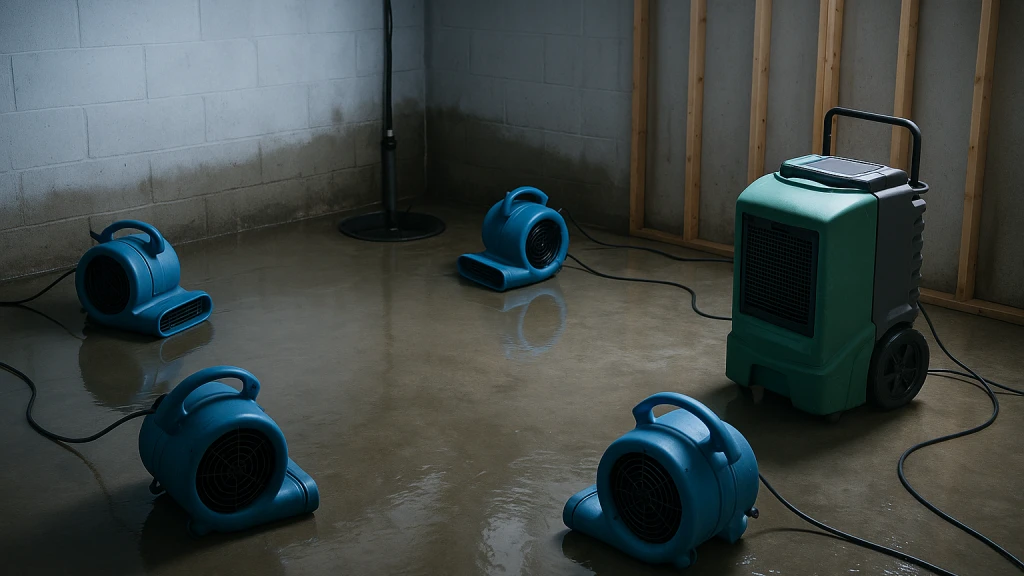
In a flood, the clock is the enemy
Water damage is the fastest route to a serious mold problem, because mold doesn't need weeks — it can begin growing in wet drywall, carpet, and pad within 24 to 48 hours. In Saint Paul, the triggers come in distinct seasonal flavors: a pipe that bursts during a January cold snap, an ice dam that sends meltwater pouring down an interior wall in February, a sump pump that fails during the spring thaw, a sewer or storm backup after a summer downpour, and overland flooding in the low-lying and river-adjacent parts of the city. They all share one truth: how fast and how completely you dry the structure determines whether you have a cleanup or a mold remediation.
The mistake that costs homeowners the most is assuming that once the visible water is gone and the surfaces feel dry, the problem is over. It usually isn't. Water wicks into wall cavities, under flooring, into the bottom of drywall, and through insulation, where it sits and feeds mold long after the floor looks dry. Professional drying exists precisely because surface-dry and structurally-dry are very different things, and only the second one keeps mold from taking hold.
The first 24–48 hours
If you're dealing with active water damage right now, a few steps protect both your home and any insurance claim while help is on the way:
- Stop the source if you safely can — shut off the water main for a burst pipe, kill power to a flooded area before entering.
- Get standing water out and lift what you can off the wet floor — furniture, boxes, anything that will wick or stain.
- Document everything with photos and video before you remove or discard anything, for your insurance claim.
- Start air moving — fans, open interior doors, a dehumidifier — but don't assume DIY drying reaches the cavities.
- Treat sewage backups as hazardous — category-3 "black water" needs professional handling, not a mop and a shop vac.
- Call for professional drying fast, because the difference between hour 12 and hour 48 is the difference between drying and remediating.
How professional water-damage response works
A licensed water-damage and mold crew in Saint Paul typically moves through these stages:
- Water extraction: removing standing water with truck-mounted or portable extraction units.
- Assessment and mapping: using moisture meters and thermal imaging to find how far water migrated into walls, floors, and cavities.
- Controlled demolition: removing unsalvageable wet materials — soaked carpet pad, the bottom of drywall, ruined insulation — to open the structure for drying.
- Structural drying: placing air movers and commercial dehumidifiers and monitoring daily until materials hit a verified dry standard.
- Antimicrobial treatment: treating surfaces to suppress mold during and after drying, especially when response was delayed.
- Mold remediation if needed: if growth already started, transitioning to full containment and removal.
- Reconstruction: rebuilding what was removed once the structure is verified dry.
The Saint Paul water-damage calendar
Different seasons bring different failures, and knowing the pattern helps you stay ahead of it. Winter is burst-pipe and ice-dam season: pipes in exterior walls and unheated areas freeze and split, and ice dams push meltwater into ceilings and walls. Spring is thaw-and-snowmelt season, when saturated ground overwhelms drainage and sumps, and basements that were fine all winter suddenly take water. Summer brings the heavy downpours that cause sewer and storm backups and overwhelm low-lying areas. A home that's dried properly and fast after any of these events usually avoids mold entirely; one that's left to "dry on its own" is the one we get called about two months later. Our guide on what to do after water damage covers the response in more detail.
What water-damage mold remediation costs
If you catch it fast and it's clean water, professional drying alone is the least expensive outcome — you're paying for extraction, equipment, and a few days of monitoring. Costs rise sharply with delay, with the volume of material that has to be removed, and with water category: a contaminated sewage backup requires more aggressive removal and disposal than a clean supply-line break. Once mold has established, you add containment and remediation on top of drying. This is the area where speed most directly saves money, which is why the right move during active water damage is to call immediately rather than wait and see. Our estimator can sketch a remediation range, and if water is coming in now, reach us or call right away so we can get a licensed local crew moving fast.