
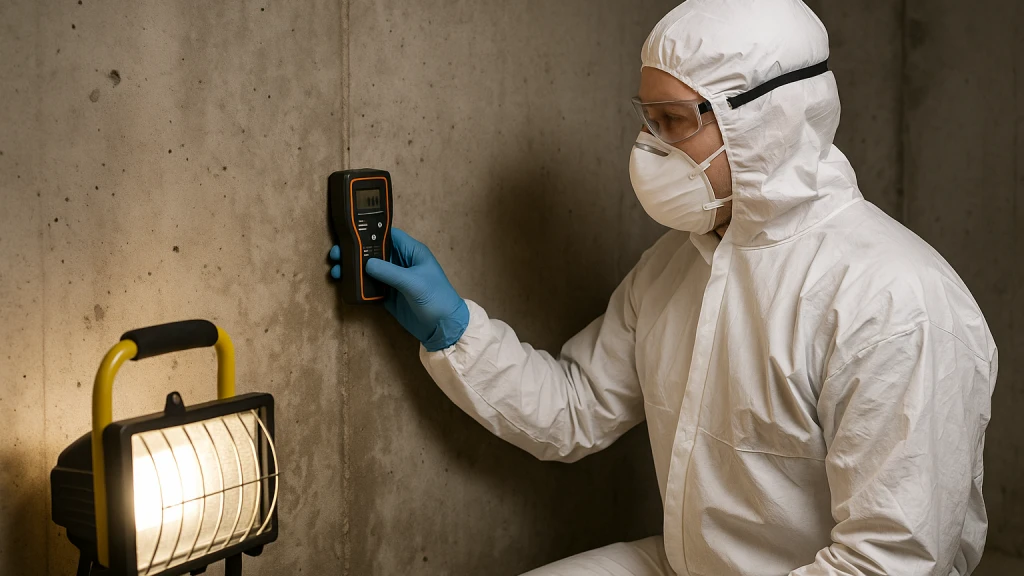
When a Saint Paul home actually needs testing
Most people who call about mold testing don't really need a lab report — they need to know two things: where the water is coming from, and how far the problem has spread. In a Saint Paul home that usually starts with a musty smell in a finished basement, a stain blooming on a Crocus Hill ceiling after an ice dam, or black speckling on the drywall behind a couch on an exterior wall. A good inspection answers the practical questions first. It maps the moisture, identifies the source, and tells you whether you're looking at a weekend wipe-down or a contained remediation. Sampling is a tool used in service of that, not the headline.
That distinction matters here because our climate hides moisture in specific, repeatable ways. Cold Minnesota winters drive warm indoor humidity toward cold surfaces — rim joists, the top of foundation walls, attic sheathing — where it condenses out of sight. Humid July and August load basements with damp air that finished walls trap against cool concrete. An inspector who understands those patterns can usually find the real cause in an afternoon, while a stranger who treats Saint Paul like a dry climate will chase the visible stain and miss the leak feeding it.
What an independent inspection includes
The independent inspectors in our network are paid to find the truth, not to sell you a remediation job, and that independence is the whole point. A typical Saint Paul inspection covers:
- A moisture survey with meters and often an infrared camera, reading walls, floors, ceilings, the rim joist, and around any past leaks to find where water is or has been.
- A visual assessment of the basement, bathrooms, attic, around windows, and the mechanicals — water heater, furnace condensate, washer hookups, and the sump pit.
- Humidity and dew-point readings, because in a cold climate the relationship between indoor humidity and cold surfaces is often the whole story.
- Source diagnosis: grading and gutter problems, a failing sump, a slow supply-line drip, ice-dam intrusion, a cracked foundation, or simply chronic high humidity.
- Sampling when it's warranted — air samples (indoor versus an outdoor baseline) and surface or tape-lift samples sent to an accredited lab for species and spore-count analysis.
Air, surface, and clearance testing
There are three common reasons to actually run lab samples on a Saint Paul home. The first is confirmation: you smell something musty but can't see growth, and an air sample comparing indoor spore counts to outdoors can tell you whether there's a hidden source. The second is scope: surface or tape-lift sampling on visible growth identifies what you're dealing with and whether it's the kind of water-damage mold that demands containment. The third — and arguably the most valuable — is clearance testing after remediation, an independent check that confirms spore levels are back to normal before the wall goes back up. We generally suggest that the company collecting clearance samples be different from the one doing the removal, so nobody is grading their own homework.
What testing won't do is give you a single safe-or-unsafe number. There is no federal threshold for "acceptable" indoor mold, and any company that hands you a scary number and an instant quote in the same breath should make you cautious. Sampling is most useful as a before-and-after comparison and as a way to settle a real estate dispute or a stubborn health question, not as a sales prop.
The cold-climate moisture sources we look for
Because the inspectors in our network work Saint Paul homes year-round, they know the usual suspects by neighborhood and by season. In older Mac-Groveland and Dayton's Bluff homes, it's stone and block basements that wick groundwater and stay damp at the cove joint. In Highland Park and along the river bluffs, it's a high water table and hydrostatic pressure pushing moisture through the slab. Across the whole city in winter, it's attic condensation and ice dams; in late summer, it's basement humidity; and any month of the year, it's the slow plumbing or appliance leak that a finished basement hides for weeks. The inspection's job is to name which of these you have so the remediation actually fixes it.
Inspection before remediation, every time
The most common and expensive mistake we see is paying to remove mold before anyone has diagnosed the water. Remove the drywall, treat the framing, rebuild the wall — and if the seepage or the leak is still there, the mold comes back behind your new finish within a season. That's why a legitimate process starts with finding and stopping the moisture source, and why an honest inspector will sometimes tell you the fix is a regraded downspout and a dehumidifier rather than a four-figure remediation. Our cost guide walks through how inspection and testing fit into the overall budget, and the estimator lets you sketch a remediation range once you know the scope.
What it costs and what you walk away with
A straightforward visual mold inspection in the Saint Paul area commonly runs in the low-to-mid hundreds; adding lab samples raises it depending on how many you collect and the lab fees. Some companies credit the inspection fee toward remediation if you hire them, though we think the cleaner arrangement is an independent inspector with nothing to gain from the result. Either way, you should walk away with a written report: where moisture was found, the likely source, photos, any lab results, and a clear recommendation. That document is what lets you get honest, apples-to-apples remediation quotes — and it's exactly what you want in hand if a home sale, a landlord, or an insurance claim is involved. Tell us what you're seeing and we'll match you with a licensed, independent Saint Paul–area inspector for a free, no-pressure conversation.