
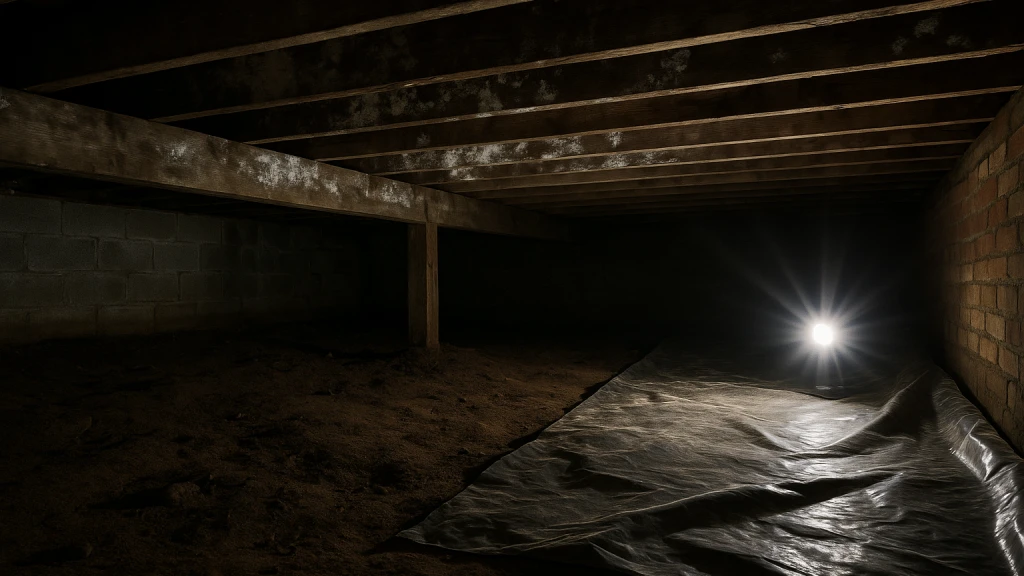
Out of sight, but tied to the air you breathe
Plenty of Saint Paul homes — especially older houses with additions, porch enclosures, and rear extensions built over the decades — have a crawl space rather than a full basement under part of the structure. Because nobody goes down there, crawl-space mold can grow for years before anyone notices, and by then it's often coating the floor joists, the subfloor above, and the insulation hanging between them. The reason it matters even though you never see it is the stack effect: in a cold climate, air in the house rises and escapes at the top, which pulls replacement air up from the lowest point of the home — and that means a meaningful share of the air you breathe upstairs has passed through the crawl space first. A moldy, musty crawl space quietly feeds the whole house.
Crawl spaces are mold-prone for a simple reason: they sit on or near the ground, and the ground is a constant moisture source. A bare dirt floor evaporates water vapor continuously. Add Minnesota's high water table, spring snowmelt, and the humid summer air that condenses on cool crawl-space surfaces, and you have a space that wants to be damp. The vintage approach of leaving crawl spaces vented to the outside actually makes it worse here in summer, when warm humid outdoor air pours in and condenses on the cool framing.
What's actually driving the moisture
An effective crawl-space remediation starts by identifying which moisture sources are in play:
- Ground evaporation from an exposed dirt or gravel floor with no vapor barrier, releasing water vapor day and night.
- Bulk water intrusion from poor exterior grading, downspouts, or snowmelt running toward and into the space.
- Humid-air condensation in summer, when outdoor air entering through vents condenses on cool joists and ducts.
- Plumbing and duct leaks running through the crawl space, dripping unnoticed for months.
- Missing or fallen insulation that has absorbed moisture and become a mold reservoir of its own.
The crawl-space remediation process
A licensed crew working a Saint Paul crawl space generally follows this arc, fixing the environment so the mold can't simply return:
- Access and assessment: getting safely into the space, documenting the extent of growth, and finding the water sources.
- Source control: correcting grading and drainage, fixing leaks, and stopping bulk water before anything else.
- Removal: taking out moldy, moisture-laden insulation and any unsalvageable material, and bagging it under containment.
- Cleaning and treatment: HEPA-vacuuming and treating the joists and subfloor; in heavy cases, media blasting the wood clean.
- Drying: using dehumidification and air movement to bring framing to a verified moisture content.
- Encapsulation: installing a heavy vapor barrier over the floor and up the walls, sealing vents, and often adding a dedicated dehumidifier to keep the space permanently dry.
Why encapsulation is the modern fix
The old wisdom — vent a crawl space to the outside — was wrong for cold, humid-summer climates like ours, and most current building science favors sealing and conditioning the space instead. Crawl-space encapsulation means covering the ground and walls with a durable vapor barrier, sealing the outside vents, air-sealing the rim, and adding humidity control so the space stays dry year-round. For a Saint Paul home, that does three things at once: it stops ground moisture from feeding mold, it keeps humid summer air from condensing inside, and because crawl-space air rises into the house, it improves the air and even the comfort and energy use upstairs. It's a bigger up-front step than spraying the joists, but it's the difference between solving the problem and repainting it every few years.
What crawl-space mold removal costs
Crawl-space pricing depends heavily on access, size, and how much remediation versus moisture-control work is needed. Tight, low-clearance spaces cost more to work in; large spaces need more material; and a full encapsulation with a vapor barrier and a dedicated dehumidifier is a substantial add-on beyond the basic cleanup. That said, encapsulation is usually the better long-term value, because a cleaned-but-still-damp crawl space simply regrows mold. The cost guide covers how these projects are priced, and the estimator helps you sketch a range. If you've noticed a musty smell, cold floors, or high humidity upstairs and suspect the crawl space, an inspection is the right first step — or just tell us what's going on and we'll match you with a licensed local pro.