
When mold isn't in one room anymore
Most mold jobs are local — a bathroom, a stretch of basement wall, an attic. But sometimes the problem has spread far enough that fixing one room at a time no longer makes sense. Whole-home remediation is for those situations: a major event or a long-running condition has put mold in multiple areas at once, and the home needs a coordinated plan rather than a series of disconnected repairs. In Saint Paul, the homes that reach this point usually got there one of a few ways — a long indoor season of unmanaged humidity, a significant flood or sewer backup, a roof or plumbing failure that went unaddressed, or a vacant or neglected property where moisture had free rein.
The hallmark of a whole-home problem is that the mold has a system-wide cause, not just a local one. When the entire house is too humid, when a forced-air furnace has been circulating spores from a moldy basement into every room for months, or when a building-wide envelope failure is letting moisture into several assemblies at once, you can't solve it by remediating room by room — you'd just watch it reappear next door. These projects start with understanding the home as a single moisture system.
How whole-home projects are scoped
A credible whole-home remediation in Saint Paul begins with a thorough assessment that treats the house holistically:
- Whole-house moisture mapping — basement, crawl spaces, attic, walls, and mechanicals — to find every area of active or past growth.
- Identifying the system-wide driver — chronic humidity, a flood, HVAC contamination, or an envelope failure — not just the visible spots.
- HVAC evaluation, because ductwork and air handlers can move spores everywhere and become a reservoir themselves.
- A phased plan that sequences the work, prioritizes the worst areas, and keeps the family safe (or relocated) during the messiest phases.
- A clear scope and clearance strategy so everyone knows what 'done' looks like and how it will be verified.
The coordinated remediation process
Whole-home work uses the same containment-first principles as a single room, scaled up and sequenced across the house:
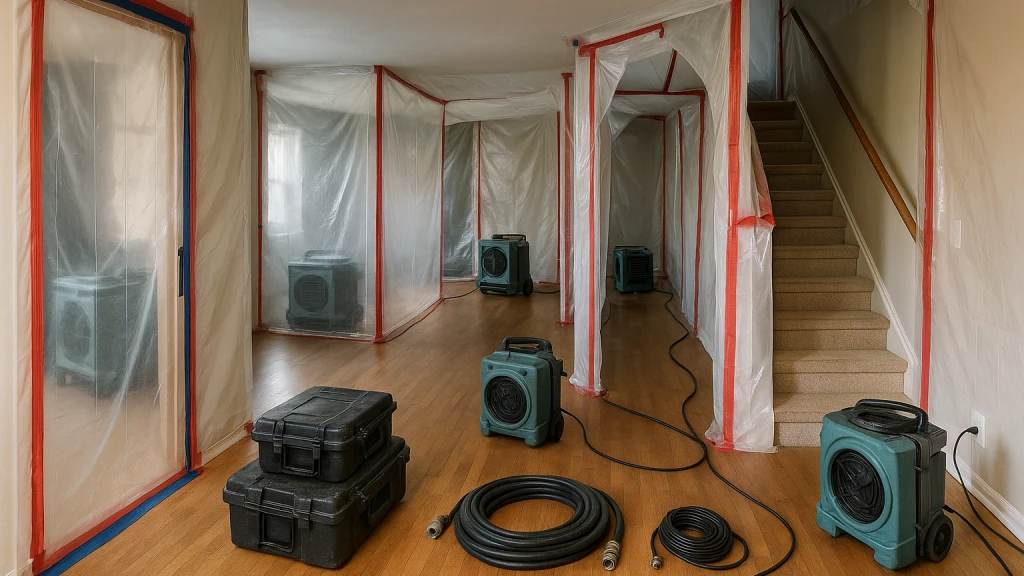
- Multiple containment zones with negative air pressure, isolating work areas so remediating one space doesn't contaminate a clean one.
- System-wide source control: fixing the humidity, drainage, roof, or plumbing problems driving growth across the home.
- HVAC remediation: cleaning or replacing contaminated ductwork and components so the system stops spreading spores.
- Staged removal and treatment of affected materials, area by area, with HEPA filtration running throughout.
- Whole-house drying and dehumidification to bring the entire structure to a stable, safe moisture level.
- Independent clearance testing before reconstruction, ideally by a third party, to confirm each area is genuinely clean.
The HVAC factor in a cold-climate home
One reason mold goes whole-home in Saint Paul specifically is our heating season. For half the year, a forced-air furnace runs constantly, pulling air from the lowest, dampest part of the house and pushing it into every room through the ducts. If there's a mold source in the basement or a moldy cold-air return, that system becomes a distribution network, seeding spores throughout the home and turning a basement problem into a house problem. Any honest whole-home plan has to evaluate the HVAC system — sometimes it's a victim that needs cleaning, sometimes it's the highway that spread the problem, and either way it has to be addressed or the remediation won't hold.
Living through a whole-home remediation
These are larger projects, and part of doing them right is managing the human side. Depending on scope, families sometimes stay in unaffected areas behind containment, and sometimes relocate during the most disruptive phases. A good contractor is upfront about the timeline, the dust and noise, which rooms will be off-limits when, and what the air will be like during active work. They'll also coordinate with your insurance where a covered event — a burst pipe, a backup, a sudden flood — is involved, since whole-home claims hinge on good documentation. The goal is a clear, phased plan you understand before anyone opens a wall.
What whole-home remediation costs
Whole-home projects are, unsurprisingly, the largest mold jobs, and the range is wide because no two are alike — a moderate multi-room remediation is very different from gutting and rebuilding a flood-soaked or long-neglected house. The cost is driven by the number of affected areas, how much material must be removed and rebuilt, whether the HVAC system needs remediation, and the corrective work required to fix the system-wide moisture source. Because these are major investments, getting more than one detailed, itemized scope is worth the time, and our cost guide explains what a fair whole-home estimate should include. If your home has mold in several places at once, or you've bought or inherited a property that's clearly been wet for a long time, tell us what's going on and we'll connect you with a licensed local pro for a free, no-pressure assessment.