
Minnesota's surprising mold problem
People are often surprised that mold is a serious issue in a cold northern climate like Saint Paul's. Mold feels like a problem for humid southern states, not a place that spends months below freezing. But Minnesota homes grow mold year-round, and the reasons are baked into our climate and housing stock. Mold needs three things: moisture, organic material to feed on, and time. Our homes supply all three in abundance, and our extreme seasonal swings create moisture in ways that warmer climates simply don't experience. Understanding why is the first step to keeping your home dry.
Winter: warm wet air meets cold surfaces
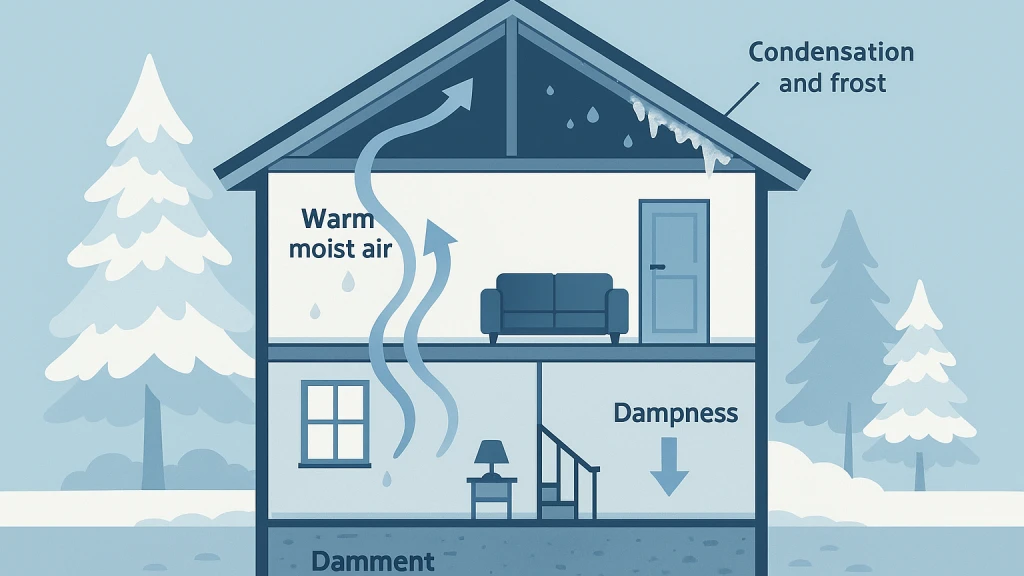
The defining feature of a Minnesota winter, from a moisture standpoint, is the enormous temperature difference between inside and outside. Your heated home is full of humidity — from cooking, showering, breathing, plants, and just living — and warm air holds a lot of moisture. When that warm, humid indoor air reaches a cold surface, it condenses into liquid water, exactly the way a glass of ice water sweats on a summer day. In winter, the cold surfaces are everywhere the building meets the outdoors: the attic roof sheathing, the rim joist at the top of the foundation, the inside of exterior walls, and cold window frames. Moisture condenses on these hidden surfaces and feeds mold all winter long, completely out of sight. This is why attic mold and rim-joist mold are so common here.
Ice dams: winter water in your walls
The other classic winter mechanism is the ice dam. Heat escaping into the attic melts the underside of the snow on your roof; the meltwater runs down to the cold eaves and refreezes, building a dam of ice; and water pooling behind that dam backs up under the shingles and into the roof, walls, and ceilings. That water then sits in the structure and grows mold once spring arrives. Ice dams are a uniquely cold-climate problem, and they put liquid water inside your house in the dead of winter. Our ice dam guide covers the mechanism and prevention in depth.
Summer: humidity and cool basements
Then the season flips. Minnesota summers are genuinely humid, and that warm, moist July and August air is heavy with moisture. When it gets into a basement and meets the cool concrete and block of a foundation — which stays cold because it's surrounded by earth — it condenses, just like the winter mechanism in reverse. This is why so many Saint Paul basements smell musty in summer even with no leak: it's condensation, not seepage. Finished basements make it worse by trapping that damp air against cold walls. Our basement prevention guide addresses the humidity side.
Spring and fall: thaw, rain, and groundwater
The shoulder seasons bring liquid water from outside. Spring thaw releases a winter's worth of snow into the ground all at once, raising the water table and pushing groundwater against foundations. Heavy spring and fall rains do the same. Homes near the river bluffs, near lakes like Como and Phalen, and in low-lying areas feel this most, with seepage at the cove joint and through slabs under hydrostatic pressure. Our water damage page covers what happens when that water gets in.
Old housing stock makes it worse
Saint Paul's housing is old — many homes date to before 1940, with stone and block foundations, original or retrofitted insulation, and decades of remodeling. These homes weren't built with modern moisture control, and even well-meaning energy upgrades can backfire by trapping moisture if air-sealing and ventilation aren't handled together. The result is a building stock that's especially prone to the condensation, seepage, and hidden-leak problems our climate creates. Our neighborhood pages get specific about how this plays out across the city.
The long indoor season
Finally, there's time. Minnesotans spend a huge share of the year indoors with the windows shut, which means our homes are sealed up and recirculating their own air for months. That long closed-up season gives any moisture problem ample time to grow and gives mold spores ample time to accumulate in the air we breathe. It's part of why mold and indoor air quality matter so much here. Our mold and health page covers the human side. If you suspect your home has a moisture problem, tell us about it and we'll connect you with a local pro who understands cold-climate building science.