
What 'black mold' actually is
The phrase gets attached to any dark patch, but true black mold — Stachybotrys chartarum — is specific. It feeds on cellulose (drywall paper, wood, cardboard) and it needs sustained moisture, not a brief humidity spike. For it to take hold in a Saint Paul home, something has to keep a material wet for days at a time: a supply line weeping behind a wall, an ice dam pushing meltwater into a ceiling, a basement that seeps every thaw, or a sump that failed while you were away. It tends to look wet or slimy rather than fuzzy, and it carries a strong, earthy, musty odor that lingers even after you've wiped the surface clean.
The health concern is real but often overstated online. Stachybotrys and similar water-damage molds can aggravate asthma, allergies, and sinus problems, especially for children, older adults, and anyone immunocompromised. The responsible message is simple: you don't need to panic, but you also shouldn't dry-scrub it yourself and send a cloud of spores through a closed-up winter house. Removal should be contained and methodical.
Why DIY bleach makes it worse
Bleach is mostly water, and water is what black mold wants. On a porous surface like drywall, bleach lightens the stain you can see while the mold's roots survive in the gypsum behind it — and the moisture you just added feeds regrowth. A bleached spot over an unfixed leak always comes back. Worse, wiping or brushing aggressively launches huge numbers of spores into the air, where a forced-air furnace distributes them room to room through the whole house in minutes. Proper remediation isolates the area first, removes the affected porous material instead of painting over it, and dries everything to a verified moisture content before any rebuild.
The containment-first removal process
A licensed crew handling a black-mold job in Saint Paul generally follows a sequence built to keep spores from spreading:
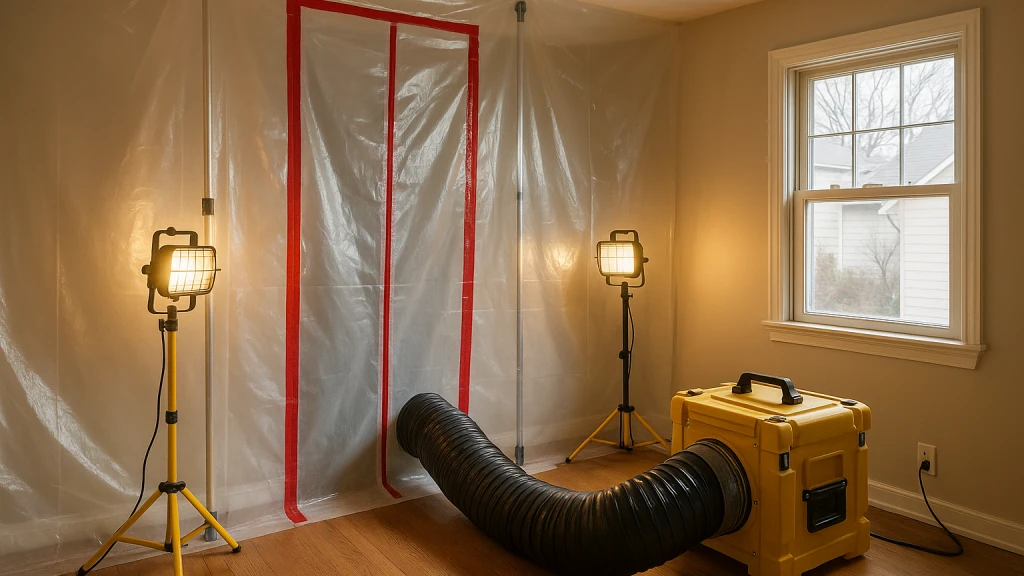
- Containment: sealing the work area with poly sheeting and running a HEPA-filtered negative-air machine so spores can't drift through the home or the duct system.
- Source control: stopping the water first — the leak, the seepage, the ice-dam intrusion — because removal is pointless while the material is still getting wet.
- Removal: cutting out and bagging contaminated drywall, baseboard, and insulation; HEPA-vacuuming and damp-wiping salvageable framing.
- Treatment: applying an EPA-registered antimicrobial to remaining structural surfaces.
- Drying: dehumidifiers and air movers until framing and subfloor hit a safe, measured moisture content.
- Clearance: ideally an independent post-remediation test before anything is closed back up.
Where black mold hides in Saint Paul homes
Because our cold climate concentrates moisture in predictable places, black mold tends to show up wherever water is trapped against cellulose out of sight. The usual spots: the bottom of basement drywall and behind paneling where the wall seeps; under-sink cabinets and behind vanities on slow supply-line drips; ceilings and wall tops below an ice dam or a roof-flashing leak; around the rim joist where warm indoor air condenses on cold framing in winter; and inside wall cavities near a failed window seal. In older Dayton's Bluff and West Seventh homes, dark mold often appears at the base of stone and block walls where groundwater meets the interior finish. The common thread is always trapped, long-standing moisture — find that, and you've found the mold.
What black-mold removal costs
Because Stachybotrys signals materials that have stayed wet long enough to need replacement, these jobs price toward the porous and structural end of the scale — commonly $15–30 per square foot for drywall and insulation, and more where framing or subfloor is involved. Toxic-appearing mold also adds a containment and disposal premium of roughly 15–25%. A single contained cabinet or closet might be a four-figure job; growth that has spread across several rooms from a long-running leak can reach five figures. Our estimator lets you sketch a range before you ever pick up the phone, and the cost guide breaks down how the pricing works.
Why containment comes first, every time
The defining feature of black-mold work isn't a special chemical — it's containment. Before anything is disturbed, the work area is sealed and put under negative air pressure with a HEPA scrubber, so that breaking into the colony doesn't broadcast spores through the rest of the house. Technicians wear respirators and disposable suits, wet materials are bagged inside containment, and porous materials like saturated drywall and insulation are removed rather than treated, because you can't reliably clean mold out of something that absorbs it. After removal, surfaces are HEPA-vacuumed and wiped, the space is dried, and many pros recommend post-remediation verification to confirm spore levels are back to normal before the rebuild. Skipping containment is the single most common way a DIY cleanup spreads the problem instead of solving it. If you suspect black mold, the safest first step is an independent inspection to map the moisture and scope the work, then a free, no-pressure quote from a licensed local crew.