
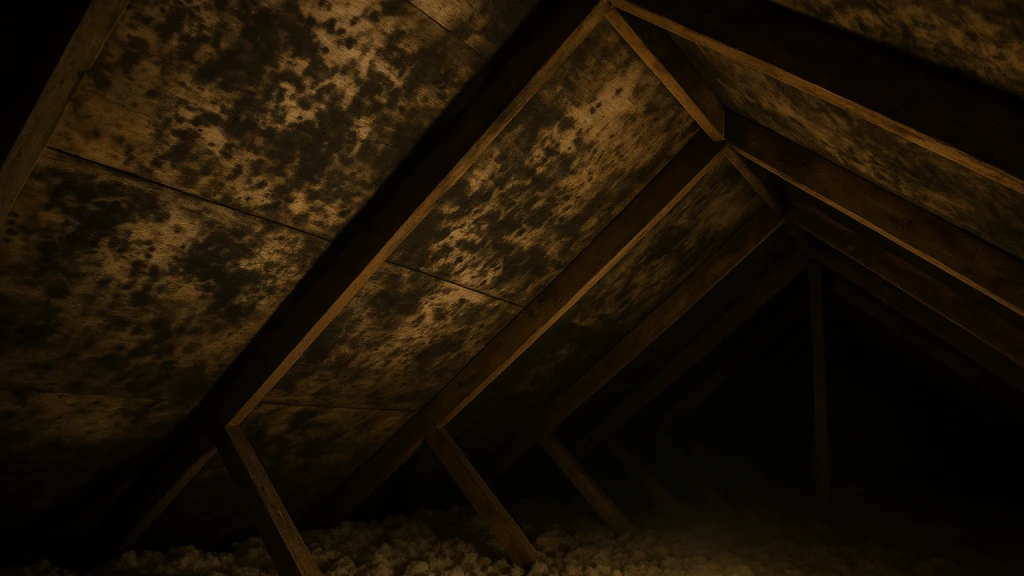
The Saint Paul attic problem is a winter problem
Attic mold in Saint Paul is almost always a cold-weather story. All winter, warm, moist air from your living space — from showers, cooking, laundry, and just breathing — rises and leaks into the attic through gaps around light fixtures, the attic hatch, plumbing stacks, and poorly sealed top plates. When that warm, humid air hits the underside of frigid roof sheathing, the moisture condenses, and in a hard Minnesota cold snap it actually freezes into a layer of frost on the wood. Then a thaw or a warm spell arrives, the frost melts, and the sheathing gets soaked. Repeat that cycle through a long winter and you get exactly what mold needs: wood that stays wet, over and over, for months.
That's why attic mold here looks the way it does: dark gray or black staining across the underside of the roof decking and along the rafters, heaviest on the cold north slope and near the eaves where ventilation is worst. Homeowners usually discover it by accident — pulling holiday decorations from the attic, during a roof replacement, or when a home inspector flags it during a sale. The good news is that attic mold is rarely a health emergency, because the attic is largely isolated from your living air. The bad news is that it signals a moisture-and-ventilation defect that will keep producing mold until it's corrected.
Why ventilation and air-sealing matter more than the mold
You can scrub or treat every square foot of stained sheathing and it will come right back if the underlying causes aren't fixed. Effective attic remediation in Saint Paul is really three jobs in one: stop the warm moist air from getting into the attic, give the attic enough cold-air ventilation to carry away what does, and only then clean up the existing growth. The moisture sources we look for include:
- Air leaks from the living space — the can lights, bath-fan housings, wiring penetrations, and the attic hatch that let warm humid air pour upward.
- Bath and kitchen fans venting into the attic instead of all the way outside — a shockingly common find that dumps shower steam straight onto cold wood.
- Blocked or insufficient ventilation — soffit vents buried under insulation, missing baffles, or not enough intake and exhaust to keep the attic cold and dry.
- Ice dams and roof leaks that push liquid water in at the eaves and around flashing during the freeze-thaw cycle.
- Compressed or missing insulation that lets heat escape unevenly, warming the roof and feeding the ice-dam cycle.
The attic remediation process
A licensed crew handling a Saint Paul attic generally works through a sequence that fixes the cause before treating the symptom:
- Assessment: confirming the moisture pattern, checking ventilation and insulation, and finding where house air is leaking into the attic.
- Air-sealing: sealing the penetrations, hatch, and fixtures that let warm humid air rise into the attic.
- Ventilation correction: clearing soffit intakes, adding baffles, and balancing intake and exhaust so the attic stays cold and dry.
- Fan rerouting: making sure bath and kitchen fans vent fully to the exterior, not into the attic or soffit.
- Mold removal: HEPA-vacuuming and treating stained sheathing and framing; in severe cases, media blasting or replacing badly degraded decking.
- Insulation work: restoring or upgrading insulation to even out the roof temperature and break the ice-dam cycle.
Ice dams: the link between your roof and your ceilings
Saint Paul winters are practically engineered to produce ice dams. Heat escaping into the attic warms the roof deck, snow melts, the water runs down to the cold eave and refreezes into a ridge of ice, and behind that dam meltwater backs up under the shingles and into the structure. That water shows up as stained ceilings and wet wall tops in the rooms below, and the same trapped moisture that ruins drywall also feeds mold in the attic and wall cavities. Because the root cause — heat loss and poor ventilation — is shared, fixing your attic the right way is also the most durable defense against ice dams. Our guide on ice dams and attic frost goes deeper, and the water-damage page covers what to do when an ice dam has already leaked into living space.
What attic mold removal costs
Attic jobs vary widely because the price depends far more on the corrective work than on the staining itself. A modest attic with light surface growth, some air-sealing, and a couple of ventilation fixes is a relatively contained project; a large attic with heavy growth, degraded sheathing, rerouted fans, and a full insulation upgrade costs considerably more. Because attic surfaces are mostly non-porous wood, much of the growth can be cleaned and treated rather than removed, which helps — but the ventilation and insulation corrections are where the real value (and most of the cost) lives. Sketch a range with our estimator, and remember that the cheapest "just spray it" quote is usually the one you'll be paying twice. Tell us what you found up there and we'll connect you with a licensed local pro for a free assessment.