
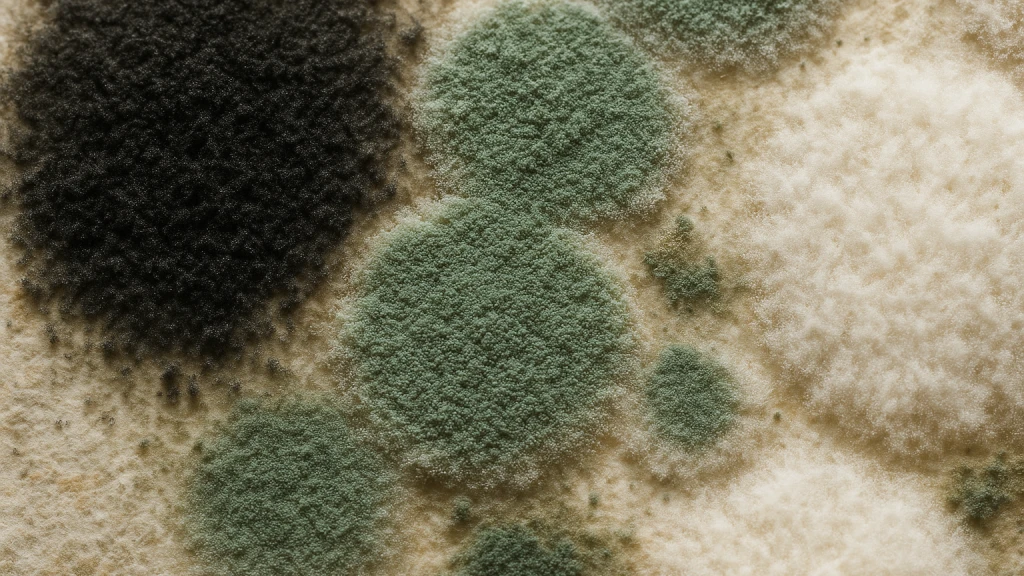
The molds that show up in Saint Paul homes
There are thousands of mold species, but a handful account for the vast majority of what actually grows in Saint Paul homes. Knowing a little about them helps you understand what you're looking at and, more importantly, what it tells you about the moisture problem behind it — because the species that appears is largely a function of how wet a material is and how long it's been wet. A practical note before we start: for most homeowners, identifying the exact species matters less than recognizing that any indoor mold means a moisture problem that needs fixing. The cleanup approach is broadly similar regardless of type. With that said, here's what commonly turns up here.
Cladosporium
Cladosporium is one of the most common molds, indoors and out, and it's a frequent find in Saint Paul homes. It typically appears as olive-green, brown, or black spots and can grow on a wide range of surfaces — painted walls, around windows where condensation collects, on fabrics, in bathrooms, and on damp wood. It tolerates cooler conditions better than many molds, which makes it well suited to our climate and to the cold, damp surfaces our winters create. It's a common allergen and a sign that a surface is staying damp.
Aspergillus and Penicillium
These two are often discussed together because lab reports frequently group them, and both are extremely common indoors. They appear in many colors — greens, blues, yellows, grays, white — and grow on damp walls, in insulation, on stored items in humid basements, in HVAC systems, and on a variety of household materials. They thrive in the chronically damp, humid conditions that Saint Paul basements develop in summer and that hidden leaks create year-round. Both are common allergens, and some Aspergillus species are of more concern for people with weakened immune systems. Their presence usually points to ongoing humidity or a moisture source that needs addressing.
Stachybotrys: "black mold"
Stachybotrys chartarum is the infamous "black mold," and it deserves a clear-eyed explanation. It's a dark greenish-black, often slimy or wet-looking mold that grows specifically on water-saturated materials high in cellulose — wet drywall, paper, cardboard, and wood that have stayed wet for an extended period. That last point is the key: Stachybotrys signals a serious, sustained moisture problem, like a long-running leak, flooding, or chronic seepage. It's the mold most associated with health concerns in the public imagination, and while the science on its specific toxicity is more nuanced than headlines suggest, it absolutely warrants prompt, careful, contained removal. Our black mold removal page covers the proper approach.
Alternaria and others
Alternaria is another common allergenic mold, often dark and fuzzy, that shows up in damp bathrooms, under leaky sinks, and anywhere water sits. You may also encounter Aureobasidium (often pink or black, around windows and on caulk), Chaetomium (in chronically water-damaged materials, with a distinctive musty smell), and various others. Again, the specific name matters less to your response than the consistent message they all send: something is too wet for too long.
What the species tells you about the moisture
Here's the genuinely useful insight. The mold you have is a read on your moisture problem. Molds like Cladosporium on a window or bathroom surface often point to condensation and humidity. The Aspergillus/Penicillium group points to chronic dampness or a humid basement. And Stachybotrys points to materials that have been truly saturated for a long time — a real leak or flood. So when a lab report comes back, the most valuable thing it tells you isn't a scary name; it's a clue to how bad and how long-standing your moisture source is. Our inspection and testing page explains how sampling fits into diagnosis.
What it means for remediation
Across all these types, the remediation principles are the same: find and fix the moisture source, contain the work area, remove materials too damaged to clean, clean and treat what remains, and verify the result. More dangerous or saturated situations — especially Stachybotrys and other water-damage molds — call for more containment and care, but the logic doesn't change. Don't let a frightening species name on a report panic you into an overpriced job, and don't let a "common" species lull you into ignoring a real moisture problem. If you've found mold of any kind and want it identified and handled correctly, tell us about it and we'll connect you with an independent Saint Paul pro.